
Scrolling through rich, mouthwatering food videos is often blamed for unhealthy eating habits. Yet recent research suggests a surprising shift in how digital food content affects behavior. Instead of pushing people toward overeating, it may quietly help some individuals stay on track with their diet goals.
A study led by researchers at the University of Bristol, in collaboration with the University at Buffalo School of Management, examined how people respond to food-related content online.
The research involved 840 participants between the ages of 19 and 77, combining surveys with controlled lab experiments. The goal was simple: understand whether watching indulgent meals online increases or reduces actual food intake.
Visual Cravings vs. Real Consumption
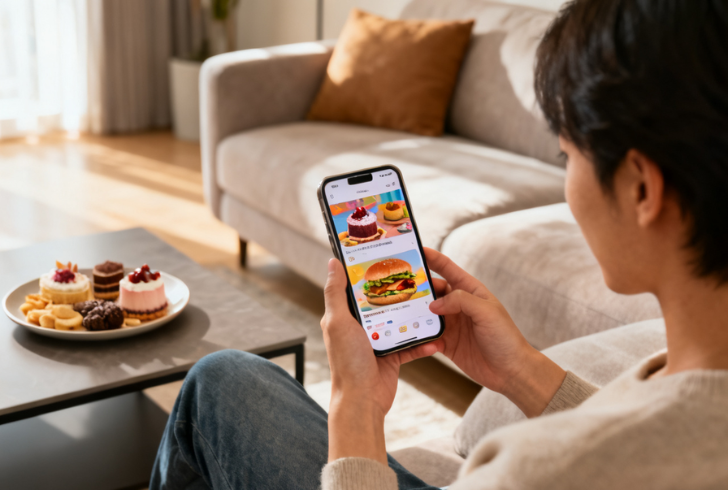
One experiment focused on short, social media-style clips featuring both high-calorie and low-calorie chocolate desserts. Participants who were actively dieting spent about 30 percent more time watching indulgent options compared to those not dieting.
The outcome, however, shifted expectations. When given access to real chocolate afterward, these same participants ate noticeably less. This pattern suggests that visual exposure may satisfy cravings before they turn into action.
Lead author Esther Kang described this behavior as “digital foraging.” The idea points to a simple but powerful shift—people may use visual content as a way to experience food without physically consuming it.
How the Brain Responds to Food Imagery
A second experiment expanded the range of food shown. Participants watched videos featuring items like pizza, burgers, and chips alongside lighter choices such as salads and smoothies. Once again, individuals focused on dieting showed a clear preference for high-calorie visuals, spending up to 50 percent more time engaging with them.
Despite this increased exposure, their eating behavior did not follow the same direction. Researchers linked this to a concept called cross-modal satiation. In simple terms, the brain can partially satisfy cravings through sight alone, reducing the urge to eat.
Co-author Arun Lakshmanan explained, “Visual consumption can, in some cases, reduce the urge to eat.” This challenges the long-standing belief that food imagery always leads to higher consumption.
Rethinking the Impact of Food Content
The findings arrive at a time when weight management remains a major focus for many. Around 60 percent of women and 40 percent of men in the United States are actively trying to manage their weight. At the same time, the global weight-loss industry has grown beyond $250 billion.
Traditionally, food advertising and visual exposure have been viewed as triggers for unhealthy habits. This study adds a new layer, showing that the relationship between what people see and what they eat is not as direct as once thought.
For individuals working on their diet, social media may serve as a low-cost and widely accessible tool to manage cravings. Instead of avoiding tempting content, some may benefit from controlled exposure.
What This Means for Everyday Habits

The research suggests that watching food content is not always counterproductive. For people trying to stay disciplined, it may even reduce the likelihood of overindulgence. Still, the effect is not universal.
Factors such as self-control, personal habits, and environment all play a role. Visual exposure should not replace actual nutrition or balanced eating. It works best as a small part of a broader approach to managing food choices.
What Future Research Could Reveal
Researchers plan to explore how different types of food content influence behavior across various platforms. Questions remain about how long the effects of visual satisfaction last and whether similar outcomes appear in real-world settings outside controlled environments.
As digital media continues to shape daily routines, even simple actions like watching a food video may carry subtle influence. The idea that a screen can help manage cravings adds a fresh perspective to how modern habits interact with health.
The connection between food content and eating behavior is more layered than expected. Visual exposure does not always lead to consumption; in some cases, it may help reduce it. This shift highlights how the brain responds to sensory input and how digital habits can influence real-life choices.
While not a complete solution, mindful engagement with food content may offer a practical way to manage cravings in everyday life.